The Aetherseeker's Logbook
The Aetherseeker's Logbook — Narration
The following entries are attributed to Captain Grundrik Ironhand, master of the Aetherseeker and commander of the Ironbound Expedition, which entered the Shrouded Isles fifty-two years ago under royal charter from King Brokk Grudgeborn. Unlike many earlier accounts, Ironhand’s surviving log does not begin in panic. It begins with the satisfaction of a captain who has spent years proving a theory and is not sorry to have been right.
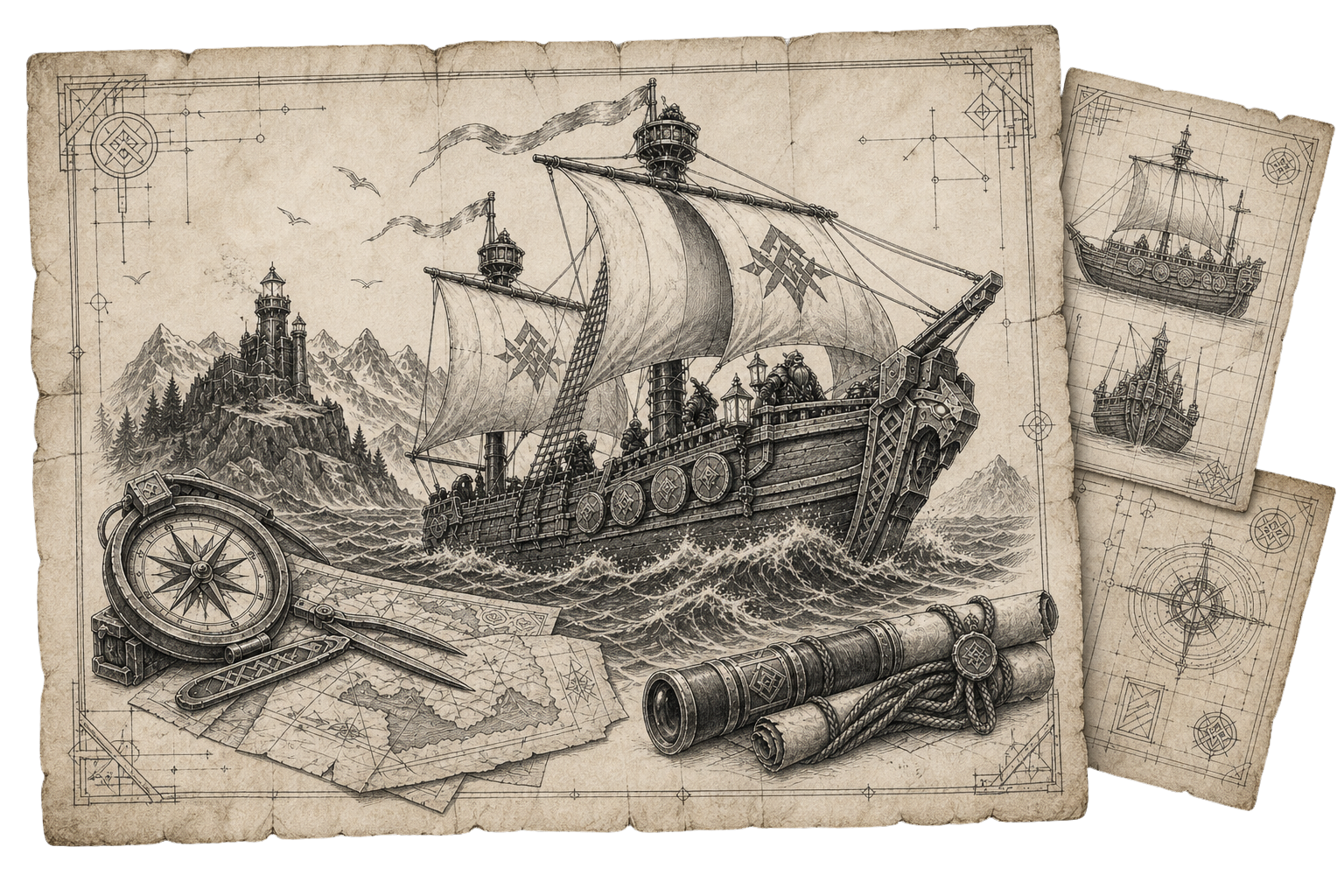
What follows is incomplete, but far less damaged than the pages recovered from the Silver Meridian. Portions of chart margin and cartographers’ notes survive alongside the captain’s hand and appear to match the map enclosed with this log.
First day within the veil
Entered under reduced sail and proper order. Visibility poor but not useless. No man aboard may now claim the Shrouded Isles were a fiction invented by idlers and gulls. We have them under our keel and before our eyes, and if the price of vindication proves steeper than comfortable men ashore suppose, then so be it. The Aetherseeker was not fitted out for comfort.
Cartographers already at work whenever the weather permits. I have ordered every distinct landform marked, however provisional the naming. There is no profit in being the first sensible expedition into a place if we then behave like fools and fail to write things down.
Third day
The northern mountain serves as reference from remarkable distance whenever the cloud lifts. It dominates all bearings and likely all local weather besides. For now we have marked it as Dreadwake Isle, preserving the name given us in dockside warnings before departure. Sailors’ tales are often nonsense in the mouth and useful on paper.
The men expected immediate catastrophe, having heard too many songs and too few navigators. What they have found instead is a place that demands work. Reef, rain, treacherous water and ugly shores, yes, but not impossibility.
Fifth day, chart margin
Arch isle to west confirmed. Local name retained: Smuggler’s Arch.
Lighthouse isle to east likewise noted. Crow’s Lantern, though no keeper observed.
Seventh day
We have made better progress than the older accounts deserved. That is not arrogance but arithmetic. We came provisioned, armed, disciplined, and with tradesmen enough to repair what lesser ventures would lose. The stories that frightened cautious men into staying home have served us well by teaching us what not to do.
Tenth day
A central isle marked by a great standing stone has yielded fresh water and a fair anchorage for short work. Marauder’s Rest, according to a local phrase later repeated to us in Blackquay. I would not rest there longer than necessity required, but I record the name because names are handles, and a place with a handle is already half easier to think about than one without.
Nearby waters are cluttered with smaller hazards. One jagged cay has been entered as Wyrmtooth, and rightly so. Another island to the south bears a single vast tree and old stones beneath its canopy. Several men reported unease ashore. Men report unease anywhere the rain outlasts the rum ration, so I attach no prophecy to it. Still, it goes on the chart as the Veiled Reach because the mist hangs there low and stubborn even in clearer weather.
Twelfth day
Blackquay at last.
If the archipelago possesses a civilised harbour, this is as close to one as any honest description should admit. The place is built in the carcass of an older township, its surviving quays fashioned from black stone no present inhabitant can name. Whole buildings have been patched from wreck timber against older walls. Salvagers, fishers, smugglers, castaways, traders and their descendants live there by accumulation of habit and warning more than by comfort. They know the channels that kill. Ask why the currents turn ill in one passage and kind in another and you will receive shrugs, arguments, lies, or stories involving curses. Ask where not to go and you may get a better answer.
One old woman summed up the settlement better than any census could:
People in the mists survive. They do not thrive.
I have written it down because it sounds like the kind of truth that costs many lives before becoming a proverb.
Fourteenth day
The further fact about Blackquay is stranger still. Nothing dramatic happens there. No obvious curse. No extraordinary panic. The place is miserable, watchful and poor, but not besieged. If the worst tales of these waters have substance, then Blackquay stands in an interesting relation to them. It is not hidden. It is not protected. It is simply allowed.
That irritates me more than I care to admit.
Seventeenth day
We have begun formalising names beyond those already in local use. A skull-shaped island south of our earlier route is entered as Skullwake. A broken ruin coast to the west has been marked the Sundered Shore. Farther south lies the black volcanic isle described by one Blackquay pilot with admirable economy as “the mountain what breathes warm.” Black Maw Isle will do well enough until a better term presents itself, which it likely will not.
A landing near the caverned face of that mountain recovered usable salvage from older wreckage, but the warm draught from within is difficult to account for. So too the deep rumbling heard by both shore team and ship. Geological, perhaps. Monstrous, perhaps. Either way the place is rich enough in wreckage that others will certainly risk it again.
Nineteenth day, marginal note by surveyor Halgrin
Map amended after second circuit. Distances between principal islands now judged reliable enough for use, provided captains remember that “reliable” here means better than dying ignorant.
Twenty-first day
Thus far the archipelago has behaved as a hard country rather than a haunted one. We have lost men, yes, but to hazards any sensible expedition must price in: weather, rock, foul channels, over-bold landings, and beasts the size of siege engines. I record that sentence because later pages may make a liar of it.
Twenty-fourth day
Three peculiarities now trouble me enough to set them together in one place.
First, channels once safely taken prove unexpectedly hostile on return more often than chance allows.
Second, creatures appear at moments either inconvenient beyond reason or convenient beyond reason, depending on whether they threaten us or drive us away from some chosen shore.
Third, warnings received in Blackquay, even when wrapped in obvious superstition, often prove practical in exact proportion to how little explanation accompanies them.
None of this proves design. It does suggest that dismissing all local caution as ignorance would be a rich man’s mistake.
Twenty-seventh day
Revisited Crow’s Lantern at a different tide from our first approach. Better footing than expected. Worse temper among the crew. A sentry claimed to have seen a figure on the ridge above the tower before dawn, gone by the time he drew another witness. I would ordinarily mark this down to poor sleep, except that another man on the beach described the same posture from a wholly different angle: still, upright, watching, and then absent.
I have written both reports and attached belief to neither.
Thirtieth day
There are points within the isles where one feels hunted without ever seeing hunter or hound. I dislike that sentence, but I dislike omitting it more. We changed our intended landing twice this week for reasons of weather and current. On each occasion the substitute route developed its own impediment with insulting speed: once a fouled passage, once a concentration of reef-hunters, once surf rising from tolerable to murderous in less time than it took to strike a small sail.
No one event is remarkable.
Their company is.
Thirty-third day
I remain unconvinced by every dramatic explanation aboard my own ship. Yet I would be a worse fool than any common sailor if I insisted the only choice lay between superstition and nothing. There may be a middle ground uglier than both.
Last complete entry
We sail at dawn for a farther circuit south and east, there to confirm the lesser hazards near Blackquay, the maelstrom waters, and the spine-marked shallows reported by local pilots. I have ordered duplicate copies made of the latest chart in case one set is lost. Call that caution if you like. I call it investment.
If this place possesses any appetite beyond the ordinary appetite of bad sea and worse country, then I do not think it wastes its attention everywhere at once. It notices some things and ignores others. Blackquay survives not because it is beloved, but because it is tolerated. Other routes feel opposed. Other shores feel withheld. I have no proof worth staking a king’s reputation upon, only the growing distaste of a man who suspects that the isles may sometimes choose when to be merely dangerous and when to be something more deliberate.
Final fragment
…maintain two lanterns on the quarterdeck tonight and wake me if the fog gathers against the wind again. I would sooner lose sleep than another good man to patterns we were too proud to mark when first we saw them…