A King's Bounty
A King's Bounty — Narration
Among the papers later attributed to Captain Grundrik Ironhand there survives no single neat account of how the Ironbound Expedition began. There is no grand revelation set down in one triumphant hand, no solitary map marked with a red cross, and no convenient witness who understood the whole matter from the outset. What remains instead are fragments: copied ledger notes, sworn statements, harbour tallies, letters of credit, tavern testimony, and cramped Duardin annotations linking scraps that ought never to have belonged together.
At first glance they describe different losses.
One source records thirteen heavily laden vessels departing under hired guard and failing to arrive at their destination. Another describes strange sails seen at dusk beyond a wall of sea-fog no chart acknowledged. A third, copied from an old counting-house dispute, concerns insurance claims too vast to be honoured after the disappearance of several bonded cargoes. Elsewhere a sailor insists he saw timbers ashore bearing marks from three realms at once, all from wrecks that by rights should have been separated by distance, by history, or by both.
Grundrik did not believe one story.
He believed the pattern.
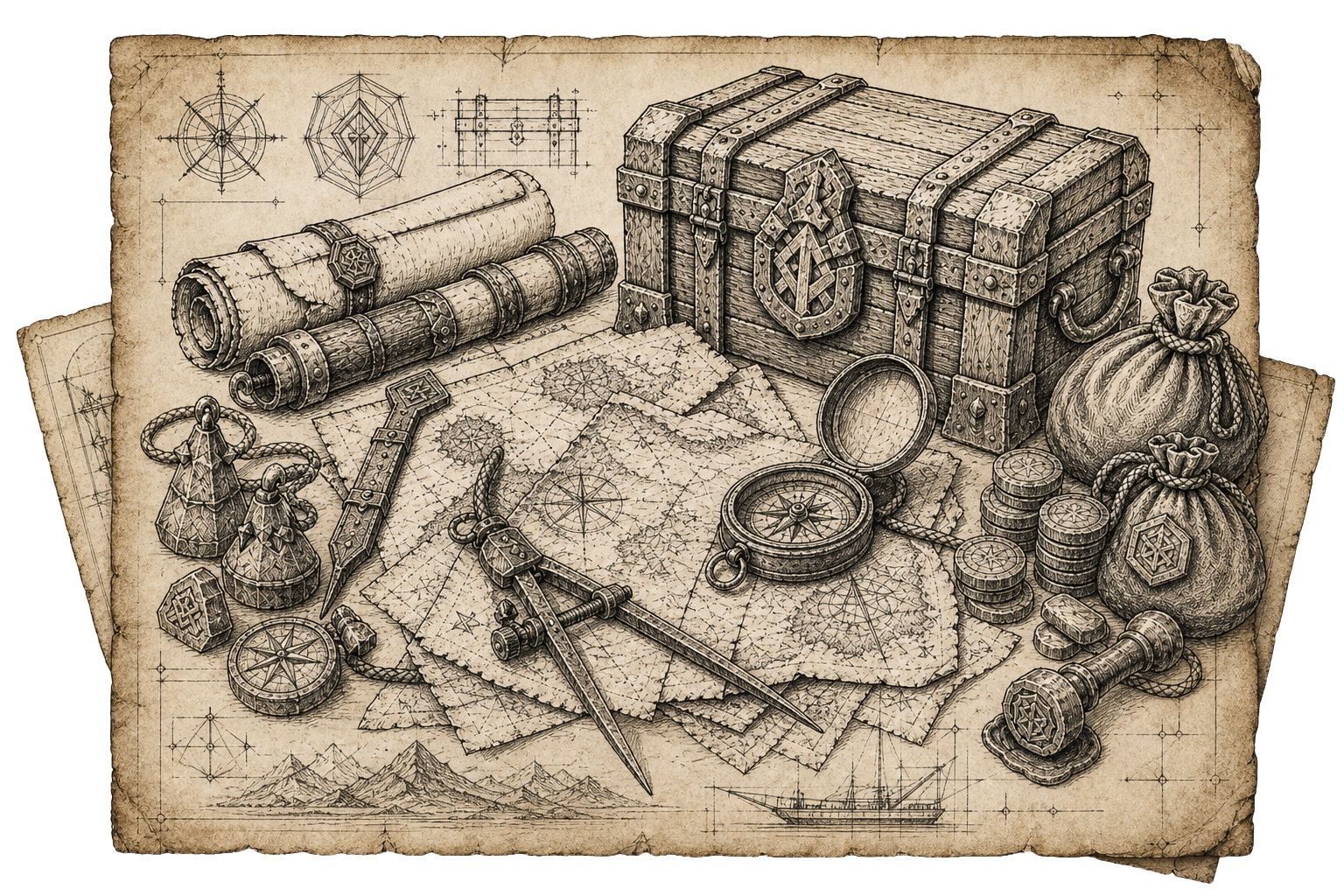
In the copies preserved with his notes, one can watch his mind at work. A margin beside a harbour register asks how many guards would be required for a cargo of mere cloth and grain. Another note, written over a half-legible manifest, wonders why so many different accounts remark upon the same thing: draught. Ships sitting low in the water. Holds burdened beyond ordinary trade. Crew lists swollen by additional marines, factors, and paymasters. More than once, Grundrik underlines the phrase heavily laden as if he feared a later reader might miss its importance.
The cargo itself is never clearly named.
That uncertainty seems only to have strengthened his conviction. One ruined document describes coin and worked silver. Another hints at gems under seal. A third suggests relics too valuable to list openly. One embittered witness, giving testimony after too much drink and too many years, swore the missing convoy carried enough wealth to ransom kingdoms. Grundrik copies the remark without comment, then beneath it writes a single line:
If even half these fools are lying, the remainder are still describing a fortune.
From there the trail deepens rather than clarifies. Old maritime superstitions begin appearing in his dossier with suspicious regularity. A navigator out of Aqshy mentions white fog where none should have formed. An Aelven pilot claims to have seen unfamiliar islands through a gap in the weather before the sea closed around him. A Duardin broker refuses to finance any voyage that attempts a certain route “when the generation turns.” Most men would have taken the contradictions for proof that the whole matter was nonsense. Grundrik, by all accounts, took them for evidence that everyone else had been asking the wrong question.
The treasure was not a legend men had embroidered.
The legend had grown around a real disappearance.
Once he had convinced himself of that much, the rest followed with iron stubbornness. If ships had been vanishing into the Shrouded Isles for centuries, then the missing fleet was only the richest single thread in a far larger weave. Lost cargo did not cease to exist because frightened sailors refused to pursue it. Ruined settlements still held stone and metal. Sunken hulls still carried nails, cannon, chain, powder, plate, timber, and coin. Armour, relics, jewels, tools, provisions, sealed chests, forgotten stores, heirlooms, and plunder from a dozen nations might all lie waiting within the same shrouded waters.
No chart could guarantee the route. No witness could say precisely where the isles would next be found. But Grundrik’s conclusion, to judge from the surviving notes, was brutally simple:
all of the stories were true often enough to be profitable.
That was the argument he eventually carried to King Brokk Grudgeborn.
The royal documents are among the clearest items in the collection, perhaps because scribes took more care with them than sailors ever did with their sea chests. They describe the granting of charter, stores, legal authority, shares of salvage, and rights of claim upon recovered treasure. They name Captain Grundrik Ironhand as master of the venture and assign crown backing to what would soon be celebrated as the Ironbound Expedition. They also make plain that Brokk did not spend lightly. Engineers, prospectors, cartographers, armed marines, labourers, factors, translators, smiths, shipwrights, and men enough to protect them all were mustered at considerable expense.
The vessel chosen for the work was the Aetherseeker.
By the time she sailed, the expedition had become famous before ever reaching open water. Tavern song and dockside gossip embroidered the undertaking further each week. Some called it the boldest treasure hunt of the age. Others said Brokk had financed a suicide of uncommon scale. Letters survive from creditors hoping to invest, from rivals hoping to delay departure, from priests warning against omens, and from opportunists offering to buy rights to whatever cargoes might be recovered first. Ironhand’s own replies, where preserved, are dry to the point of insult.
He was not chasing a ghost chest or a single golden idol.
He was going to collect a kingdom’s worth of wreckage.
Later readers would give the gathered papers a convenient title and call them A King’s Bounty. The name suits them better than any formal inventory could. At first it seems to refer to reward: the prize awaiting those bold enough to brave the mists. Then to royal patronage: the bounty offered and financed by a king. Then perhaps to something larger and harsher, for the papers describe an appetite not limited to one lost convoy but fixed upon the entire archipelago and all it had swallowed.
The last folios in the bundle contain fewer copied testimonies and more of Grundrik’s own hand. The trail is complete enough for him now. Preparations are underway. The Aetherseeker is provisioned. Charts from three realms have been compared and marked. Estimates of tide, season, and recurrence are laid out in neat columns, though even there he notes that the old tales refuse to agree. One remark survives in full:
We do not go because the sea is kind, nor because the stories are sound. We go because no man ever amassed such a quantity of warning without there being something underneath it worth the trouble.
Fifty-two years ago, King Brokk Grudgeborn’s banner flew above the Aetherseeker as she sailed toward the mists with Captain Grundrik Ironhand and the full strength of the Ironbound Expedition aboard.
No record in this bundle describes her return.