The Shrouded Isles
The Shrouded Isles — Narration
For as long as ships have crossed the open waters of the Mortal Realms, sailors have told the same sort of story in a hundred different tongues. Somewhere beyond the known lanes there lies a drowned archipelago shrouded in unnatural mist. Some call it a graveyard of fleets. Some call it a kingdom of wrecks. Others swear it is nothing more than a lie told by old hands to frighten green crews away from bad weather and black water.
Yet the story never quite dies.
One harbourmaster records a carrack vanishing between noon and sunset in calm seas. An Aelven navigator writes of islands glimpsed for less than an hour beyond curtains of white. A Duardin factor notes a convoy overdue by a month, then by a season, then forever. In taverns from one realm to the next, men and women who have never met still speak of bells heard through fog, of ruined shores laden with salvage, of shoals where the sea seems to deepen and shallow at the same time, and of a place from which no honest chart has ever returned unchanged.
The old saying is that the mists part once in a generation.
No two chroniclers agree on what that means.
Some insist the fog retreats, drawing back from hidden shores and leaving the islands exposed like the bones of some sleeping beast. Others say a passage opens through walls of cloud so high they blot out the sky. A few swear there is nothing there at all until the day the archipelago simply appears upon the horizon where open water stood the night before. The contradiction ought to have killed the tale long ago. Instead it has made it stronger. Every sailor knows the details are wrong. Too many are equally certain that the danger is real.
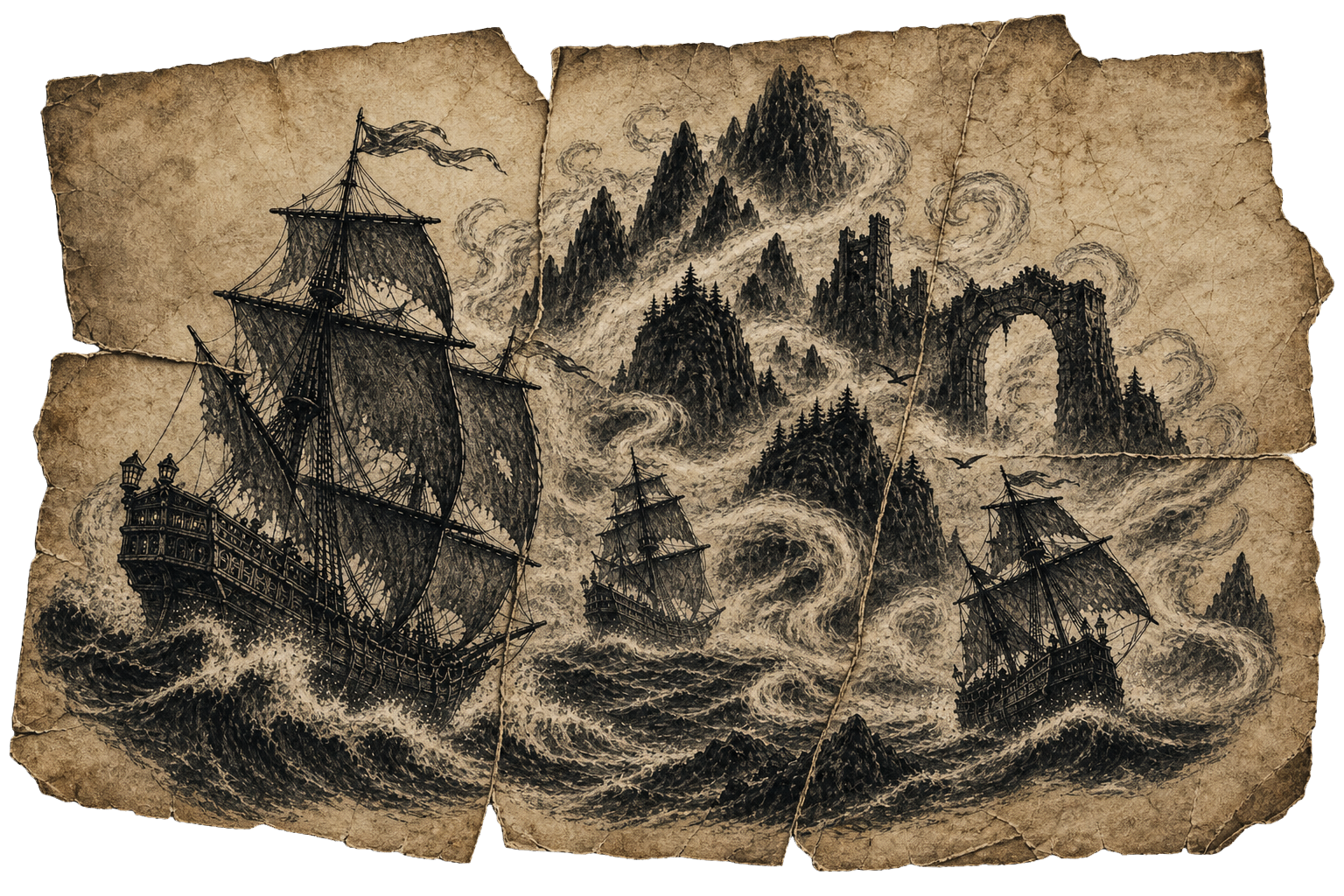
What lies beyond the mist depends upon who is speaking. Treasure hunters speak first of wealth. They tell of hulks split open upon black beaches, their holds still heavy with coin and ingots. They tell of drowned temples, broken quays, armour in the sand, and relics washed up from centuries no scholar can name with confidence. Mercenaries speak of abandoned strongholds and easy plunder. Smugglers speak of hidden anchorages and coves unmarked on any lawful chart. Priests, when they speak at all, tend to describe the place in less hopeful terms.
There are stories too of the islands themselves.
A great northern peak said to command the entire archipelago from beneath its cloud-wreathed crown. A stone arch rising from the surf like the gateway to some forbidden harbour. A lighthouse that still stands though no keeper is seen there. A skull-shaped isle where breakers foam in empty eye sockets. A cavern mouth in a black mountain that breathes warm air into cold rain. A shabby port of black quays, patched sails and old stone, where those who survive the mists barter salvage and lies in equal measure. Most of these tales cannot be proved. Enough of them overlap that few mariners dismiss them entirely.
This much is repeated often enough to be trusted: when the Shrouded Isles make themselves known, they draw the desperate and the ambitious as surely as blood draws sharks.
Captains with more courage than prudence begin fitting out ships the moment rumours spread. Debtors vanish from their creditors. Mercenary companies discover sudden interest in maritime work. Noble fools dream of founding new realms. Pirates smell fat prey. Scholars convince themselves that this time they will observe what others merely survived. Not all who approach the mists come willingly, but enough do that every opening leaves a trail of missing hulls and broken names in its wake.
The isles earn their reputation quickly.
Even without superstition, the waters are murderous. Reefs rise where soundings promised safety. Anchorages that look calm from a distance prove rotten with cross-currents. Sudden storms rake exposed decks, then vanish as sharply as they came. Shores that seem promising from offshore reveal no easy landing once boats draw near. Creatures large enough to crack longboats haunt the shallows. Stranger hazards wait inland: sour marshes, fungal groves, split rock, old ruins, and beaches where too much wreckage has accumulated for chance alone to explain it.
And still the stories go on, because danger alone would not sustain such hunger.
Men do not keep sailing toward certain death for empty fog. Somewhere within the mass of contradictions is a harder truth: the Shrouded Isles have swallowed ships, cargo, relics, weapons, provisions, and people for longer than any living realm remembers. What one captain loses, another may later find half buried in sand. What one age abandons, another rediscovers as treasure. If the mists have been feeding for centuries, then the archipelago has become a hoard assembled from the wreckage of the world.
That belief has ruined better folk than greed usually reaches.
Those who have never seen the mists imagine a clear choice waiting beyond them: fortune or death. Those who have sailed near the phenomenon describe something much crueler. They speak of confusion, separation, broken formations, glimpses cut short, and choices made too late. A ship may enter in triumph and founder in bewilderment before its crew have set eyes upon the first shore. A fleet may go in ordered and emerge within the archipelago scattered beyond recall. Survivors do not agree on what they saw. They agree only that the sea within the veil is not the same sea they left behind.
There are no useful certainties in the tale of the Shrouded Isles. There are only repeated warnings, repeated losses, and repeated temptation.
Sometimes the mists are sought. Sometimes they are stumbled into. Sometimes they seem to reach farther than expected and take ships that never meant to come near them at all. But whenever the white wall gathers, the same old bargain is offered anew. Riches enough to change a life. Danger enough to end it. A name that might live forever. A grave no one will ever find.
That is how the story always begins.
Out there, beyond the fog, lie islands hidden from the world.
And this time, for reasons of their own, they have opened their shores again.