The Cursed Archipelago
The Cursed Archipelago — Narration
By the time the last splintered ships clear enough mist to see one another, the Shrouded Isles have already done their work.
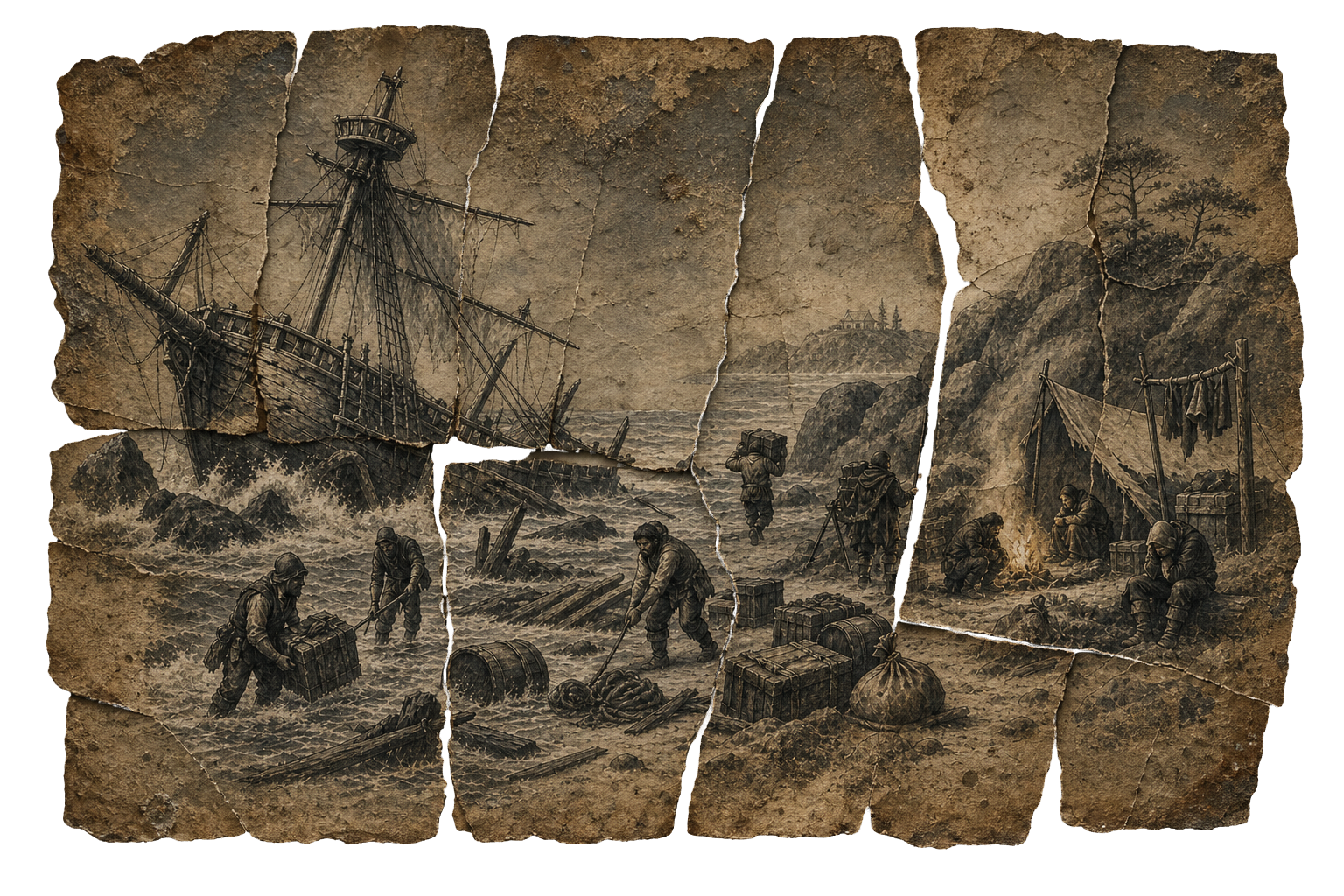
Masts are cracked. Rigging hangs in wet tangles. Oars, boats, anchors, powder, food and fresh water have all been lost in different measures aboard different vessels. Some captains still command something resembling a fleet. Others can barely account for the deck beneath their boots. Formations that entered the fog in good order have been broken into drifts of survivors, and those survivors now find themselves hemmed in by unfamiliar shores, poor weather, and the slow realisation that no safe route back presents itself behind them.
The mists have closed again.
Not every ship has wrecked outright. That would almost be mercy. Many have instead survived badly: enough hull to float, enough sail to limp onward, enough strength left in exhausted crews to row toward shelter and pray the shelter proves real. Such vessels become the first true shape of life in the archipelago. They creep from cove to cove, from beach to reef, from rumour to half-glimpsed landmark, trying to become less helpless before the isles decide to finish what the passage began.
There are islands everywhere and none of them promise permanence.
A captain may put men ashore upon one beach in the morning and be driven off by tide, monster, weather, or rival claimant before nightfall. A creek that seems fit for careening a hull may prove exposed once the wind turns. A wooded slope rich in salvage timber may already shelter another stranded warband desperate enough to kill for nails. Fresh water, repair stone, rope, tar, food, powder, and dry ground all exist within the isles, but seldom in abundance and never without cost.
So every landing becomes temporary until force, labour, or fortune says otherwise.
This is the first hard lesson of the archipelago: refuge is not the same thing as possession.
The second hard lesson is that the islands are dangerous even when no enemy banner is in sight. The coastline wrecks ships with professional indifference. The weather punishes overconfidence. Inland paths vanish into rot, scree, fungus, old ruins and stranger things besides. Great creatures hunt the shallows. Lesser things scavenge the beaches. Men already weakened by the crossing discover quickly that the Shrouded Isles do not require malice to kill them; simple exposure and bad ground are often enough.
Yet people do live here.
Somewhere out beyond the worst crossings lies Blackquay, a harbour spoken of in low, practical tones by those fortunate enough to have heard of it at all. It is no radiant sanctuary, no kingdom in miniature, and no seat of strength. It is a wet, grey free port built in and around the ruins of a far older township, its black stone quays serving ships far grander than any now tied there. Salvagers, castaways, fisherfolk, smugglers, mercenaries and descendants of the stranded endure there because it is one of the few corners of the archipelago where endurance is possible.
People in the mists survive.
They do not thrive.
That distinction matters. Blackquay is not a promise that rescue is near. It is proof only that the isles do not swallow everyone at once. Men can barter there. Learn there. Lie there. Patch their hulls, replace a spar, recruit guides, and listen to locals who know which channels break keels and which fires on distant shores should not be answered. They cannot buy certainty. No one in Blackquay possesses that much of it.
For most newly stranded captains, however, Blackquay begins as rumour rather than destination.
What is immediately real is the state of their own company. Troops must be gathered before they scatter. Wounded must be treated. Stores must be counted. Officers who were once concerned with conquest now find themselves judging rope, timber and cask-stave with the eye of quartermasters. Proud armies are reduced, for a time, to the practical business of staying fed, staying armed, and preventing panic from doing what reefs and storm failed to do.
That necessity strips ambition to its bone.
Some who entered the mists dreaming of treasure will keep dreaming of it. Others abandon grander plans at once. Escape becomes the plainest desire aboard most decks. Not immediate escape, for that is impossible with shattered hulls and scattered strength, but eventual escape. Every cask recovered, every patch hammered home, every shore secured long enough to gather stores, every rival beaten back from a useful anchorage, all become steps toward the same distant aim: to build again something seaworthy enough to challenge the veil.
Until then, the archipelago is not a prize.
It is a condition.
You wake within it half drowned, salt-stung, and short of what you need most. You do not yet control an island. You do not yet possess a harbour worth naming. You have no assurance that the next headland hides relief rather than ruin. Your first battle in these waters may not win you glory, but it may win you something rarer: a place to stand long enough to begin.
That is how the Shrouded Isles greet their newest guests.
Not with revelation.
With wreckage, hunger, bad weather, and the demand that you prove you intend to live here longer than the last poor fools washed onto these same stones.